
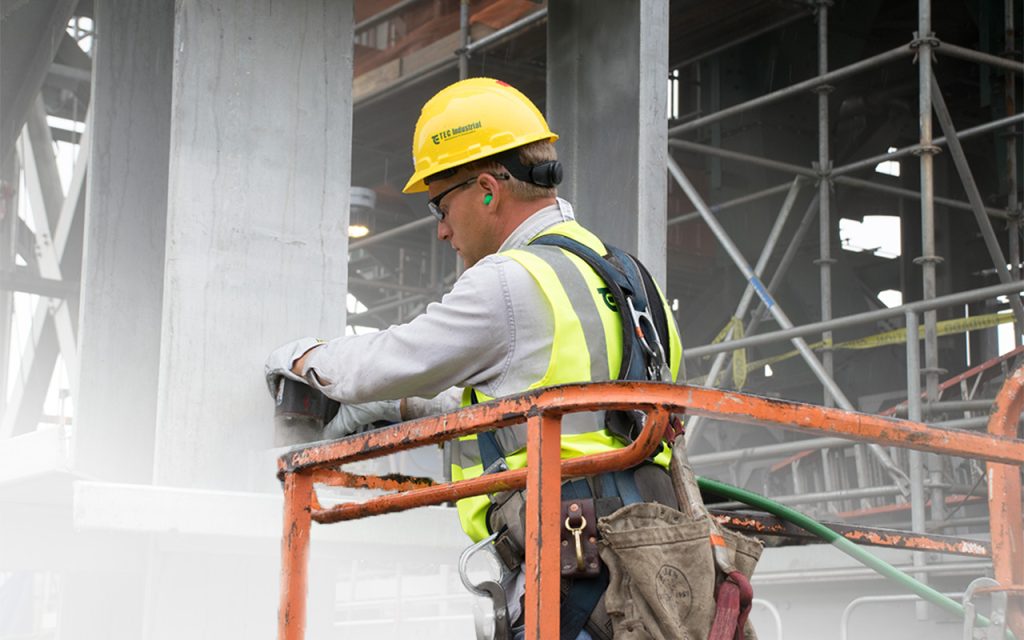
For a long time, the standard advice for young people entering into the workforce was to get a degree, find an office job, and work your way up. In 2026, that advice is becoming outdated. Artificial intelligence and other developing technologies are changing entry-level office work, and the numbers show demand for construction job growing, while demand for office jobs shrink. For anyone deciding their future career, the timing is favoring the skilled trades.
In 2023, construction employment reached an all-time high of 8.0 million jobs, passing the previous peak of about 7.7 million set in 2006. The newest BLS projections show that employment across the economy is projected to grow about 3.5%, while construction and extraction occupations are projected to grow 5.1%, adding about 385,700 jobs. Installation, maintenance, and repair occupations are projected to grow 5.4%, adding about 352,700 jobs.
What Is Driving the Demand
There are three main driving forces behind the projected construction growth:
- The country needs more electric power capacity, and BLS cites a projected increase in new capacity of 42.3% from 2023 to 2033, led by renewable sources.
- Data centers are expected to grow from representing about 4% of total electricity generation to as much as 9% by 2030, and building and cooling them takes electricians, HVAC technicians, concrete crews, and pipe fitters.
- Electric vehicle sales rose from under 1% of new vehicle sales in 2013 to nearly 10% in 2023, and every new charging station needs to be installed and connected by skilled workers.
These are long-term building needs, not short-term trends. Someone has to build and maintain the power lines, plants, and facilities behind them.
Where the Jobs Are Growing
Several of the strongest construction and maintenance occupations are in the trades. BLS projected 10.8% growth for electricians from 2023 to 2033, with about 84,300 new jobs. Heating, air conditioning, and refrigeration mechanics and installers were projected to grow 9.1% and construction laborers 8.2%. Construction laborers were expected to add the most jobs of any construction occupation, at about 115,400 workers.
The two fastest growing occupations overall, wind turbine service technicians and solar photovoltaic (PV) installers, are both closely related to construction of renewable electric power generation.
Pay is competitive too. In 2023, the median annual wage was $61,590 for electricians, $57,300 for HVAC mechanics and installers, and $61,770 for wind turbine service technicians, higher than the median for all occupations at $48,060.
Why Office Jobs Aren’t the Most Stable Choice
The same BLS projections show a very different picture for office and administrative support jobs. This group is projected to decline 4.0 percent from 2025 to 2035, the fastest decline of any major occupational group. It is also projected to lose the most jobs (about 752,100). Automation tools, including those powered by AI, are likely to reduce demand for several of these occupations even more.
Young workers are noticing. A September 2026 SimplyWise survey of 1,140 adults ages 18 to 29, reported by Associated Builders and Contractors (ABC) Greater Tennessee, found that among current college students, 52 percent said the skilled trades feel like a safer option than office jobs in an AI-driven economy. 34 percent said trade school or an apprenticeship is the best path to financial stability by age 30, compared with 23 percent who chose a four-year degree.
A Career Path You Can Visualize
One reason the trades appeal to younger workers is that the path forward is easy to picture. A person can start as an apprentice, earn wages while learning, and build skills and credentials along the way. From there, many move into craft professional roles, then foreman or superintendent, and some become estimators, project managers, or business owners. Many of these paths do not require a four-year degree to begin, and the work is something you can see and point to at the end of the day.
Technology is part of the job too. Digital plans, tablets, and layout tools are common on modern jobsites. Construction still depends on physical presence, judgment, and craft skill, which is a big part of why younger workers see it as a steady choice.
Where TEC Industrial Fits Into This Growth
TEC Industrial is a maintenance and construction company with operations across the Southeast, Mid-Atlantic, and Midwest. At TECI, we see this growth firsthand, with demand for projects and a skilled workforce increasing by the day. TECI has countless paths for advancement and training opportunities, allowing you to earn a living and develop your future at the same time.
If you are considering a career in construction, visit https://tecindustrial.com/careers/ or call (423) 247-4141 to learn more about our current opportunities today!
Sources
- U.S. Bureau of Labor Statistics, “What’s behind the projected construction employment growth from 2023 to 2033?” Beyond the Numbers, March 2025.
- U.S. Bureau of Labor Statistics, “Total employment projected to grow 3.5 percent between 2025 and 2035,” The Economics Daily, September 21, 2026.
- ABC Greater Tennessee, “Career Paths in Construction: Why Gen Z Is Reconsidering Office Work,” October 4, 2026.